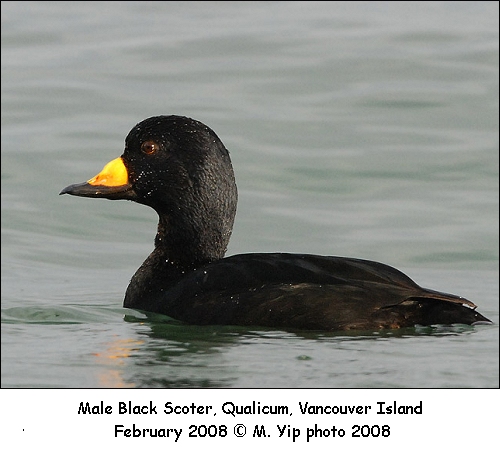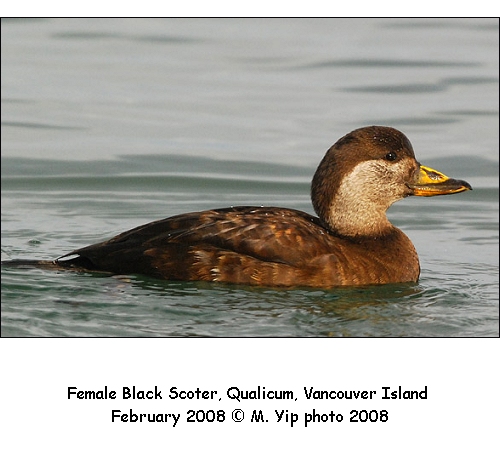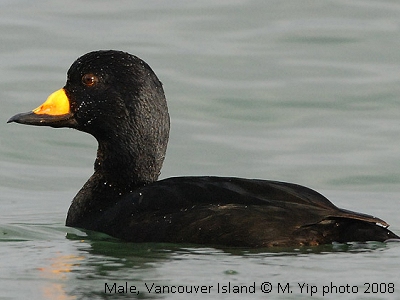

The smallest scoter. Breeds in the tundra and mostly migrates down the coastline. Feeds mainly on mollucks and crustaceans captured by diving in deep water. Common on the coast where they spend the winter. Two records to date in our checklist area of birds that apparently stopped briefly on their way to the coast. .
Similar species:
Compared to the other two scoters, the most duck-like with rounded head and smaller bill. Males distinctive. Females have a dark cap that sets off a lighter coloured face.
Best viewing locations:
Reliable viewing locations near by include White Rock, Tsawwassen Jetty and other similiar locations overlooking the ocean.
Sources:
Ehrlich, Dobkin and Wheye, (1988)
Sibley, D. 2000
Noteworthy Data
Date | Location | Source(s) | Comments |
| November 4, 2015 | Harrison Lake | G. Gadsden, 2015d | Male diving regularly 200 meters from shore. Was on its own for the most part but did join two Surf Scoter briefly. Video documentation shown below. Also seen on November 5, 2015 (D. Tyson, 2015) |
| October 20, 2009 | Harrison Lake | G. Gadsden, 2009 | Three females out on lake viewed through the scope. |
Photos